



Step 1: Store Your Rainwater
Step 2: Store Your Rainwater

Assess your rainwater collection area

Clean: Filter Leaves and debris
Filter leaves and debris
Clean: Divert the first flush of rainwater
Monitor your water level
Step 2: Store Your Rainwater
How you plan your rainwater usage and needs are key to designing an effective harvesting system.
Once you’ve established the quantity and quality of rainwater required to fill your needs, you need to determine the right storage vessel to ensure you have access to a consistent water supply throughout the year.
It’s important to reiterate that your ability to capture water is also contingent on your capacity to store it, this is where you need to look at the makeup of your property, and the storage vessels themselves. If you are just getting started, or only require a small amount of water, then a rain barrel or smaller tank will get the job done. However, if a higher quantity of water is required, we have a variety of options that can help you achieve your goals.
THINGS TO CONSIDER
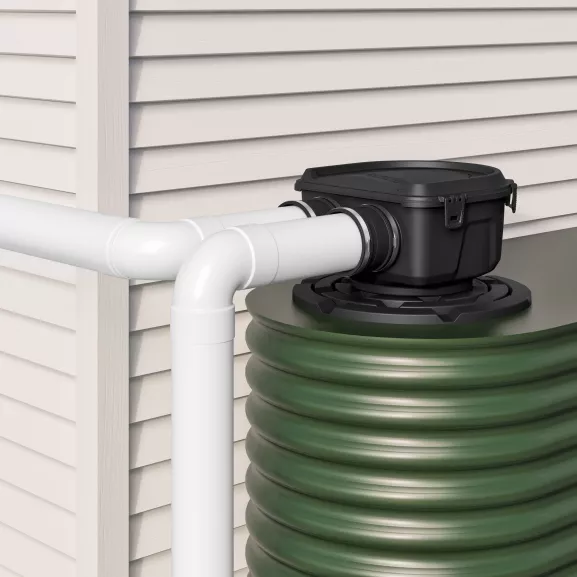
The Context
Consider the aesthetic and available space when choosing a tank type: above-ground or in-ground. Position the tank next to the building, under a deck, or down the side of the house. In-ground tanks save ground-level space and enable better fall from the gutter to the tank inlet. They also allow for larger volume tanks compared to above-ground tanks limited by house height
The Capacity
Consider material and space when choosing your tank. Materials like concrete, steel, and plastic offer durability. For limited space, a slimline tank can hug the house, while a round tank provides greater storage capacity with more space. Multiple smaller tanks can be connected to increase volume if needed, based on space constraints.
The System
When connecting your roof and downpipes to a tank, there are two main systems: Dry and Wet. A Dry System allows water to flow directly from the roof to the tank, without storing water in the pipes. It is a simple installation with existing buildings, requiring minimal plumbing or groundwork. However, connecting a large roof area may be challenging, especially with gabled roofs. In such cases, a Wet System, also known as a Charged System, is recommended. It allows for connecting a larger portion of the building to the tank by routing pipes underground and back up to the tank.